
Somewhere between surviving the day and chasing the next milestone, it’s easy to lose sight of something deeply sacred: your wholeness.
The last post, “How to Feel Whole Again: 10 Proven Steps to Reclaim Your Inner Peace,” resonated with a lot of you. However, someone asked this question: “What are some signs I’m not operating in my wholeness?” So, today’s post is all about some of the subtle signs you might experience when you’re feeling disconnected and far from whole.
You might still be checking off to-do lists, showing up for your people, even laughing on cue. But underneath it all, a quiet disconnection starts to settle in. There is an inner hum of imbalance, a quiet knowing that something in you is missing, misaligned, or muted.
15 Subtle Signs You’re Not Functioning in Your Wholeness
Wholeness doesn’t mean having your life together, being happy all the time, or reaching some personal perfection. It means being in harmony with yourself—your thoughts, emotions, values, body, and spirit. It’s feeling anchored within, even when life gets chaotic around you.
And sometimes, the signs that you’re not feeling whole are subtle—so subtle that you learn to function around them.
However, functioning isn’t the same as living, fully. So today, let’s pull back the curtain and explore 15 quiet signs that you might be feeling disconnected from your wholeness—and how you can begin the journey back.
1. You Constantly Seek External Validation
When you’re not whole, your self-worth becomes fragile—easily swayed by someone else’s opinion. You do or say something and immediately seek approval from others. If everyone dislikes it or disagrees, you immediately change your mind. You defer your choices until someone else agrees with them.
You begin to outsource your confidence, hoping that someone else’s approval will make you feel enough.
But here’s the truth: Wholeness doesn’t need applause. It creates its own echo.
Application: Try sitting with a decision without asking for anyone else’s input. Choose something small—an outfit, a weekend plan, a creative project. Affirm your choice with this mantra: “I trust myself.”
2. You Feel Emotionally Exhausted After Saying “Yes”
Your calendar is full, your energy is low, and your inner peace is nowhere to be found. If you’re constantly saying “yes” out of guilt, fear, or obligation, you may be in emotional debt—constantly giving more than you’re receiving or able to replenish.
When you keep saying yes to everyone else but no to yourself, you eventually lose the ability to hear your own needs.
Application: Pause before committing. Ask: “Am I saying yes from alignment or obligation?” Say no once this week—even if it’s uncomfortable.
3. You Compare Your Life to Everyone Else’s
You scroll through social media and feel small. You look at other people’s lives and wonder, “What am I doing wrong?” The more you measure yourself against others, the more you chip away at your self-belief. Comparison creates distortion. It magnifies what you lack and minimizes what you have. But wholeness says: I am on a different path because I was built for a different purpose.
Application: Unfollow or mute accounts that trigger comparison. Create a “wholeness highlight reel” for yourself: photos, notes, or reminders of moments when you felt most aligned and proud of who you are becoming.
4. Your Self-Talk Is More Critical Than Compassionate
When your inner voice sounds more like a bully than a best friend, you’re likely living in the gap between who you are and who you think you should be. Wholeness invites self-compassion, not self-punishment. Listen to how you speak to yourself when you fail, fall behind, or feel low. That’s where your wholeness is either protected—or under attack.
Application: Write down the last three harsh things you said to yourself. Now, rewrite them as if you were talking to someone you love. Speak that new truth to your reflection.
5. You Feel Spiritually Disconnected or “Dry”
There are seasons when the prayers feel hollow, the practices feel like routines, and the quiet places inside of us feel like the desert.
If you’re feeling spiritually empty, it’s not because you’ve failed. It may be a sign that your soul is asking for something deeper, truer, more intimate.
Application: Create space for stillness. Light a candle, breathe deeply, and ask: “God, show me where I’m hiding from you and myself.” Be still enough to hear the answer.
6. You Keep Waiting for Something (or Someone) to Make You Feel “Enough”
“When I get the promotion… “When I meet the right person… “When I lose the weight… “When I finally heal…”
That’s when you’ll feel whole, right?
We’ve all waited for the “next thing” to be the missing puzzle piece. But the truth is: wholeness can’t be delivered to your doorstep; it’s grown within you.
Application: List 3 things you’re waiting for to “finally feel complete.” Then, write one small way you can access that feeling now—before the arrival.
Example: Waiting for love? Practice self-nurturing. Waiting for success? Celebrate a small step or your current consistency.
7. You Find It Hard to Rest Without Feeling Guilty
If you feel lazy when you’re not being productive, you might be equating your worth with your output. However, productivity is not proof of value. Wholeness gives you permission to rest without explanation. It honors your humanity over your hustle. Rest is not the reward—it’s the requirement.
Application: Schedule 1 hour this week to do absolutely nothing. No productivity. No checking your phone. Just breathe, be, and notice how your nervous system responds.
8. You Can’t Sit in Silence Without Reaching for Distraction
The moment things go quiet, you grab your phone, open a tab, or scroll through someone else’s life. Stillness becomes uncomfortable because it leaves you face-to-face with yourself. When you’re whole, silence doesn’t scare you—it settles you.
Application: Create a “stillness space” in your day. No phone. No podcast. Just breathe, be quiet, and present.
“In the silence, I can finally hear what my soul has been trying to say.”
9. You Don’t Recognize Yourself Anymore
Maybe it’s been a while since you laughed deeply, dreamed boldly, or created something just because you wanted to. Maybe you’ve spent so much time being what others need you to be, you’ve forgotten who you are.
This quiet fading of identity is one of the most overlooked symptoms of inner fragmentation.
Application: Reconnect with something you used to love—drawing, dancing, journaling, singing, cooking—without trying to be good at it.
10. You’re Easily Triggered by Small Things
Little things feel like big things. Someone’s comment lingers. A missed text feels like rejection. A small mistake spirals into self-criticism. When you’re not whole, your emotional baseline becomes fragile, and everything starts to feel personal—even when it’s not.
Application: Next time something small triggers a big emotion, ask: “What is this reaction really about?” Trace the emotion to its root. The more whole you become, the more emotionally resilient you feel.
11. You’re Hyper-Focused on “Fixing” Yourself
There’s nothing wrong with self-improvement, but if you’re constantly trying to fix, upgrade, or “optimize” yourself, you might be operating from the belief that something is fundamentally wrong with you. Wholeness is rooted in acceptance, not improvement.
Application: Pause your personal growth checklist and ask: “Can I love who I am while still becoming who I’m meant to be?” Let self-love be the foundation—not the reward.
12. You Dismiss Compliments or Positive Feedback
You smile politely when someone compliments you but internally reject it. You downplay your strengths. You deflect praise like it’s a spotlight you didn’t earn. This isn’t humility—it’s a sign of internal disconnect. When you’re whole, you receive love with open hands.
Application: The next time someone compliments you, don’t deflect it. Say “thank you,” take a breath, and sit with it. Let it land.
13. You’re Overly Attached to Productivity
When your worth is measured by output, rest feels unproductive and success feels temporary. You can’t enjoy a win because you’re already chasing the next goal.
Wholeness gives you permission to slow down without shame.
Application: Block off one hour this week to do something “unproductive” but joyful—like reading fiction, taking a slow walk, or simply watching the sunset.
14. You Feel Disconnected From Your Body
You ignore hunger cues. You push past exhaustion. You numb discomfort instead of listening to it. A disconnection from the body is often a signal that we’re living outside of alignment. Your body is not a burden—it’s part of your wisdom.
Application: Try a daily body scan. Ask: “What does my body need right now?” Then actually give it—whether that’s rest, water, movement, or gentleness.
15. You Avoid Vulnerability—Even With Yourself
You say “I’m fine” when you’re not. You keep busy so you don’t have to feel. You avoid hard conversations and deep questions. But vulnerability isn’t weakness—it’s access to wholeness. You can’t heal what you’re not willing to name.
Application: Carve out 15 minutes to journal honestly. Ask yourself: “What am I afraid to feel? What am I pretending isn’t bothering me?” Be lovingly honest.
Final Thoughts:
So, what do you do if you don’t feel whole?
You don’t force it. You don’t shame yourself. You don’t pretend you’re okay.
You acknowledge it. You get curious, not critical. You trace the disconnection back to its roots. You begin small acts of return—daily, gently, honestly.
Wholeness isn’t found in a single moment. It’s restored one choice at a time.
Choose to be honest about what you feel. Choose to speak to yourself with kindness. Choose to stop waiting for someone else to give you permission to be enough. Choose to believe you are already whole—even if you’re still healing.
Reminder: Wholeness is not a destination; it’s a relationship with yourself. One that requires tending, checking in, forgiving, and beginning again.
So if today you feel scattered, disconnected, or uncertain—pause. Take a deep breath. Return to yourself.
Because no matter what you’ve lost, broken, or gone through—you are not too far from becoming whole again.
Want to explore these signs more deeply?
Here are 5 journaling questions to support your next step:
- Where do you feel most disconnected from yourself right now?
- What parts of your identity do I feel like you’re constantly justifying?
- When was the last time you felt whole? What contributed to that feeling?
- What truth do you need to remind yourself of today?
- What would it look like to be fully at home within yourself?
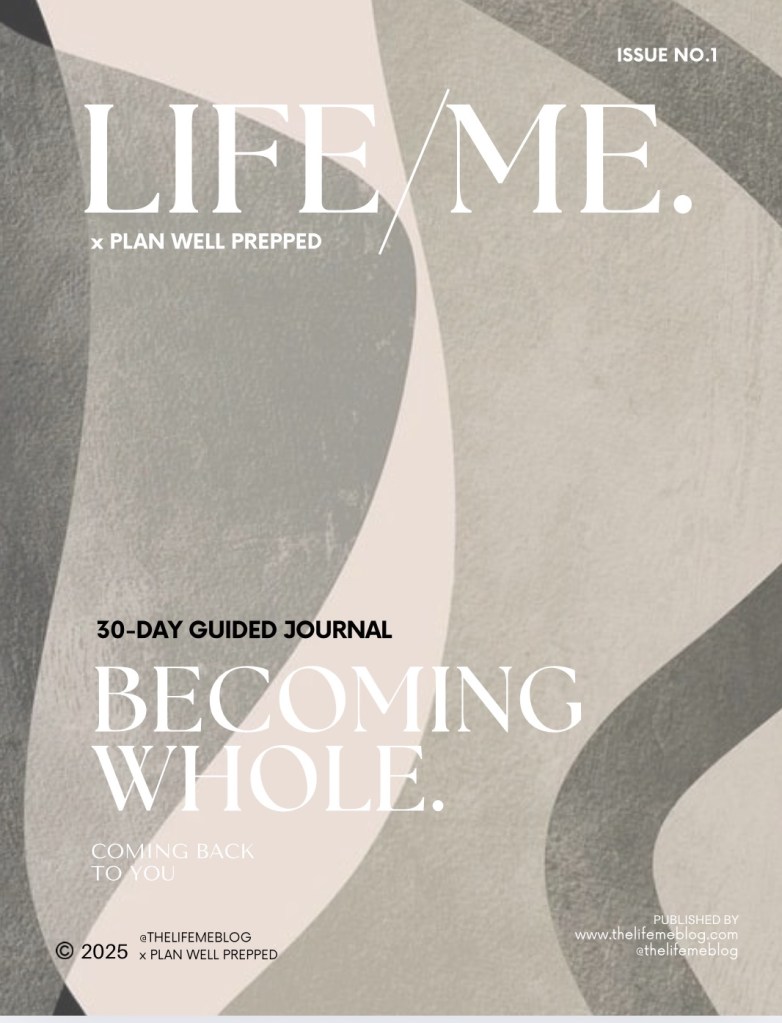
If you want to go deeper, invest 30 days in yourself! Grab your 30-Day (Printable) “Becoming Whole” Guided Journal & Prompts
Pay It Forward
If this post resonated with you, consider this your invitation to do the real, necessary work of returning to your wholeness—slowly, lovingly, intentionally. AND, consider sharing this with someone else who needs to return to remember they are inherently whole
 life/me.
What resonated with you? Why? Share your thoughts below.