
Where in your life are you feeling disjointed or disconnected today?
Life can have a way of pulling you in a dozen different directions—work deadlines, family responsibilities, friendships, social media, and the constant noise of the world. Over time, you can feel stretched so thin that you start losing touch with yourself.
It’s a little like holding a glass with tiny cracks. At first, you barely notice the slow drip. But eventually, your joy, faith, and hope start leaking out faster than you can refill them.
Have you ever felt like that?
Like no matter how hard you try, there’s a lingering emptiness, a sense that something’s “off” inside? Like no matter how hard you try, there are seasons that leave you feeling incomplete, disjointed, or depleted?
Here’s the truth: you are not broken. Wholeness isn’t about fixing yourself — it’s about returning to the truth of who you are. You were whole before life’s cracks appeared, and you can feel whole again.
Feeling whole again is possible no matter where you are in life. And it’s not perfection — it’s alignment.
“Wholeness isn’t about fixing yourself—it’s about returning to the truth of who you are.”
Why You Might Feel Disconnected Inside
I know firsthand what it feels like to get lost in the daily grind and the demands of work and life. Life can get overwhelming and move so fast that you wonder where the time went, and even where YOU went.
Being fully whole and complete is not reserved for perfect people, healed people, or people who have it all together. You don’t need to wait for a relationship, career milestone, or divine sign to start feeling whole. It’s available to you now, and it begins within.
It is not going to come from validation from others, people pleasing, or from achieving more. It has to come from instead of you: a belief, an acceptance, a knowing.
Read more about: 15 Subtle Signs You’re Not Whole
What Does It Mean to Be Whole?
When people hear the word “whole,” they sometimes imagine a person who is always happy and positive, who has it all together—flawless success—the career, the relationship, the body, the finances, and more.
But wholeness is not outer perfection, it is inner alignment. It’s the state of being where your thoughts, emotions, values, and spirit are in harmony — even when life is far from tidy. It’s knowing that even if the glass is half empty or half full, you are the glass; therefore, you are inherently whole. You just may need restoring or replenishing. You feel incomplete not because the glass (YOU) is broken; it is because the glass (YOU) is empty.
Being whole means:
- Feeling at home in your own skin.
- Choosing self-acceptance over self-criticism.
- Knowing you are not broken, even when life feels messy.
- Anchoring your identity in something deeper than external validation.
You can be whole and still have struggles. You can be whole and still be growing. The difference is that your sense of self no longer shatters when life throws you a curveball.
Why Wholeness Is Essential for Lasting Success
Many people chase achievement thinking it will “complete” them. They hustle harder, achieve more, and check every box… only to feel strangely empty inside. Is that you? Are you chasing something to make you feel complete?
Here’s the truth: Success built on depletion is fragile. Without wholeness, even wins feel hollow.
When you’re whole:
- You set boundaries without guilt.
- You show up in relationships without losing yourself.
- You make decisions from clarity, not desperation.
- You move through the world with quiet confidence, not constant comparison.
- You access clarity, resilience, and peace—even in uncertainty.
Bottom line: Wholeness isn’t a destination, it is the foundation that allows your relationships, career, and personal growth to thrive.
You can hustle toward a goal, grind through personal growth, or work on your relationships—but if you’re doing it from a fractured place, burnout and a feeling of emptiness are inevitable.
10 Proven Steps to Feel Whole Again (With Bonus Journal Prompts)
Below are ten actionable, research-backed ways to rebuild your sense of wholeness from the inside out. Each includes a reflection or action step so you can begin applying it today.
1. Acknowledge the Gaps in Your Life
You can’t fix what you won’t face. Start with honest self-inventory: What feels incomplete? Where are you disconnected from yourself?
Action Step: Write down three areas in your life where you feel “off” — without sugarcoating. Example: “I feel disconnected from my creativity,” or “I avoid dealing with conflict in my relationships.”
2. Trace the Source of Your Incompleteness
Once you identify your gaps, ask: Where did this start? Was it a childhood experience, a broken relationship, a failure that reshaped how you see yourself?
Action Step: Journal about a moment in your past that planted seeds of self-doubt or disconnection. Write down the belief you formed in that moment — and whether it’s still serving you.
Example: “After that job loss, I believed I wasn’t capable enough.”
3. Identify and Replace Unhealthy Coping Mechanisms
We all develop ways to numb pain — overworking, people-pleasing, binge-watching, or scrolling endlessly. But these survival tactics delay true healing.
Action Step: What habits do you use to avoid sitting with discomfort? How are they serving you—or sabotaging you?
List three ways you avoid sitting with discomfort. Then, next to each, write one healthier alternative.
Example: Instead of numbing with TV, take a 15-minute walk and journal what you’re feeling.
4. Redefine Your Self-Image
If your self-image is cracked by shame or comparison, no affirmation will stick. Healing begins when you see yourself as inherently worthy — not because of what you’ve done, but because of who you are.
Action Step: Write five affirmations that directly challenge your most persistent self-limiting beliefs.
Example: Replace “I’m not enough” with “I am complete and capable, exactly as I am.”
5. Accept Your Uniqueness
Comparison fragments your sense of self. Embracing your unique design is essential for wholeness.
Action Step: List three traits you used to dislike about yourself — and reframe them as strengths.
Example: “I’m sensitive” → “I’m empathetic and deeply aware of others’ emotions.”
6. Stop Looking for Completion in Others
Healthy relationships happen between two whole people — not two halves clinging together for validation.
Action Step: Reflect on a relationship where you lost yourself trying to be “enough” for someone. Write down what you learned about your need for internal wholeness.
7. Challenge the Inner Voice That Echoes Others’ Opinions
Many wounds come from internalizing hurtful things people have said. But someone’s opinion isn’t the truth.
Action Step: Write down three criticisms you’ve carried — and replace each with a more empowering truth.
8. Unplug from Society’s Standards of “Enough”
Social media and advertising constantly tell us we’re not enough — not rich enough, fit enough, or successful enough. Wholeness means rejecting those artificial standards.
Action Step: Unfollow three accounts that make you feel “less than.” Replace them with content that inspires growth and self-compassion.
9. Maintain Your Wholeness with Daily Rituals
Wholeness is a practice, not a milestone. Just as you maintain your physical health, you must maintain emotional and spiritual health.
Daily Ritual Ideas:
- Morning journaling
- Gratitude walks
- Meditation or breath prayer
- Body scan check-ins
- Mirror affirmations
10. Protect Your Wholeness Like It’s Sacred
Life will test your boundaries. People will push against your peace. Protecting your inner alignment is an act of self-respect.
Action Step: Think of one recent moment where you protected your peace — maybe by saying no or walking away from drama. Celebrate it.
Daily Wholeness Check-In
Use this five-question framework to keep your inner life aligned:
- What part of you needs attention today?
- What narrative are you rehearsing that doesn’t serve you?
- What truth can you anchor yourself in today?
- Where do you feel out of balance, and why?
- What’s one small act of self-alignment you can take right now?
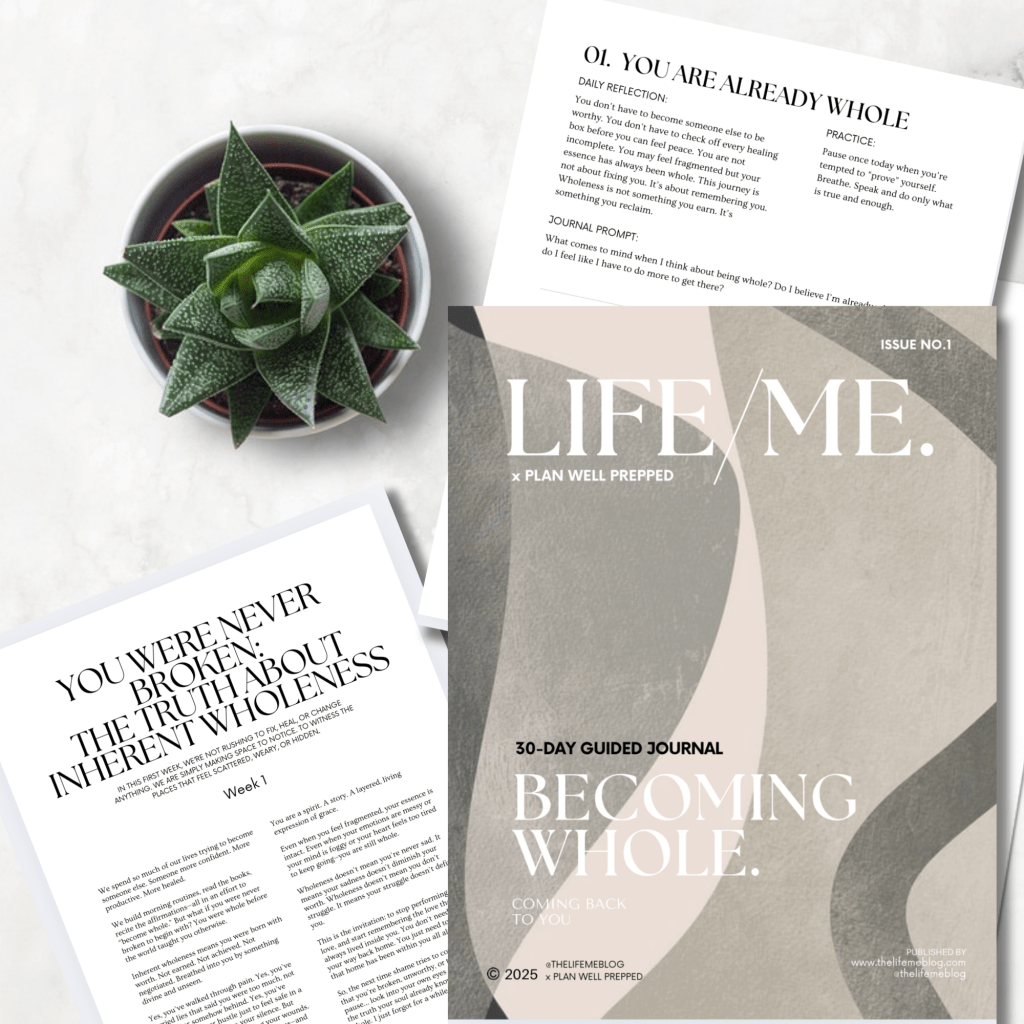
If you want to go deeper, invest 30 days in yourself! Grab your 30-Day (Printable) “Becoming Whole” Guided Journal & Prompts
Final Thoughts: Wholeness Is Your Birthright
You are not broken—you are becoming. Wholeness is not about having all the answers, but about returning to the truth of who you are.
There will be days when you feel off. That doesn’t mean you’ve failed—it means you’re human. The key is learning how to return, realign, and renew.
When you feel whole, your light becomes contagious.
So protect it. Nurture it. Let it guide your growth, your relationships, and your success.
Start your “wholeness” journey today.
Invest 15-30 minutes today in YOU! Complete one of the actions or journal prompts above or download the printable “Becoming Whole: Coming Back to You” 30-Day Guided Journal for inner alignment.
 life/me.
What resonated with you? Why? Share your thoughts below.